
1999 Penny Value: Why Most Are Common but Some Aren’t
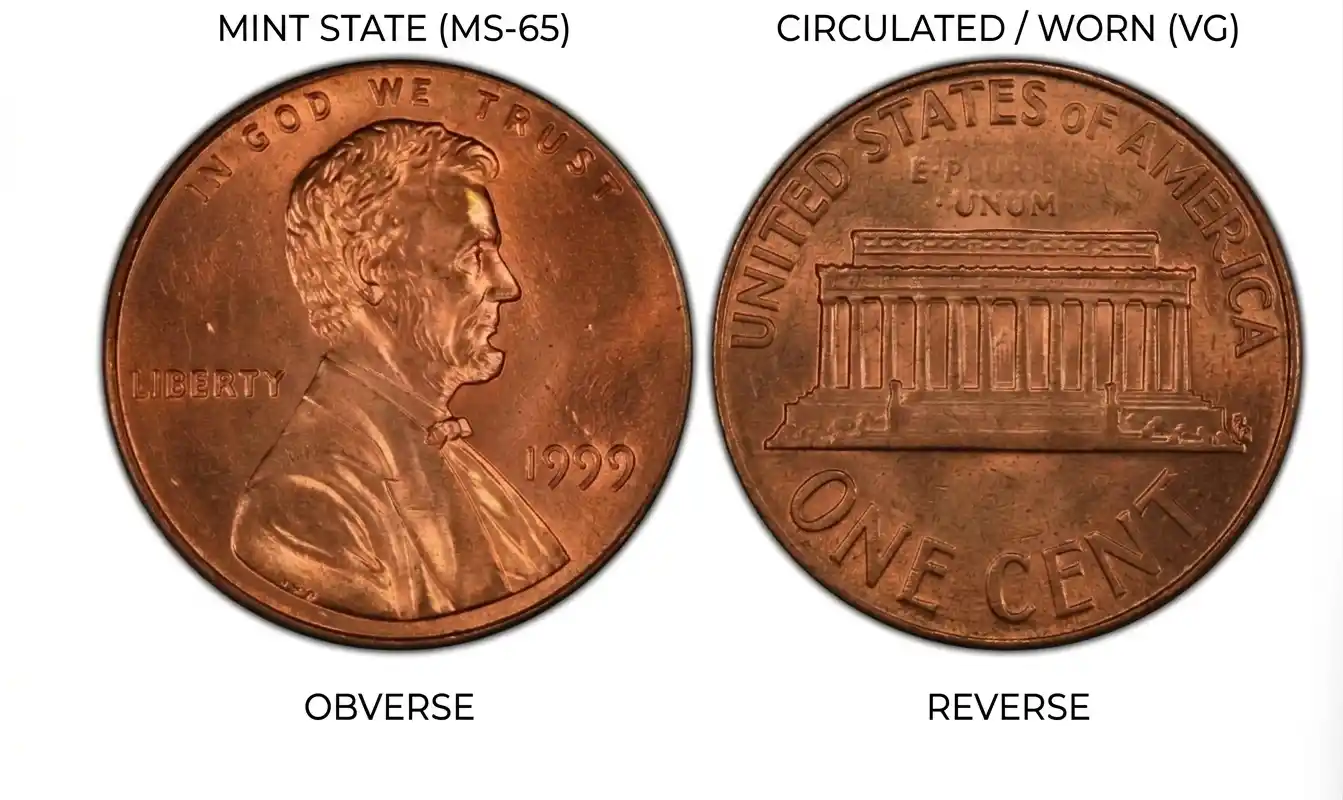
The difference lies in the details ignored by most people. And the error 1999 penny value correlates directly with the degree of its visual prominence.
Audit Item №1: Wide AM Reverse Anomaly
This incident occurred due to a breach in die selection protocols.
Using a master hub intended for collector series during mass production created a hybrid coin.
Standard items show letters A and M almost touching at their bases.
Wide AM specimens demonstrate a clearly defined distance between these characters.
Anomaly Identification Logic
Gap between A and M → Wide
FG Initials → Positioned closer to the Memorial
AMERICA font → No contact points
Finding such a coin in circulation results from a 1999 production error.
Market Value Dynamics
The coin value for Wide AM in 2026 continues rising as coins are gradually removed from circulation.
2024 year price: $465.00 per sample.
2025 year price: $535.00 per sample.
2026 year price: $610.00 per sample.
Record auction price for an MS-67 grade reached $2,400.00.
Audit Item №2: Physical and Geometric Metrics
Every item must comply with metrological standards.
Any weight deviation may indicate a specific plating flaw.
Characteristic | Standard | Unit |
Item Weight | 2.50 | grams |
Copper Layer | 2.5 | percent |
Zinc Core | 97.5 | percent |
Diameter | 19.05 | millimeters |
Thickness | 1.52 | millimeters |
Audit Item №3: Registry of Technical Failures
Press malfunctions create unique relief configurations.
Double Die
Doubling of letter or digit contours occurs due to die shifting during impact.
Slight doubling in the LIBERTY area is typical for 1999.
Minimal shift → $35.00 worth.
Noticeable doubling → $480.00 worth.
Strong doubling → $1,250.00 worth.
Off-Centre
Blank displacement relative to the striking unit's center leaves part of the field empty.
15% Displacement → $40.00 price.
60% Displacement → $180.00 price.
95% Displacement → $450.00 price.
Worth increases provided the full date remains visible on the coin.
Die Clash
Dies striking each other without a blank in between transfers the reverse design onto the obverse.
Outlines of the Lincoln Memorial columns appear on the front side.
Audit Item №4: Impact of Rot on Investment Worth
Zinc inside the coin remains highly unstable when contacting the environment.
Damaging the outer shell leads to rapid chemical degradation.
Copper breach → Moisture contacting the Zinc → Oxidation.
Bubbles appearing under the copper layer are the result.
This defect is often mistaken for a Double Die, which constitutes an error in judgment.
Random swelling → Plating damage → $0.01 worth.
Sharp doubling → Mint error → Growth in worth.
Audit Item №5: Color Grading and Significance
Copper surface color determines the rarity category in professional catalogs.
Evaluation follows three main classes.
Surface Classification
RD (Red): bright red luster.
RB (Red-Brown): mixture of red and brown.
BN (Brown): dull brown color.
Condition | 2024 price | 2025 price | 2026 price |
MS-63 BN | $130.00 | $145.00 | $160.00 |
MS-65 RD | $490.00 | $550.00 | $620.00 |
MS-67 RD | $1,950.00 | $2,200.00 | $2,450.00 |
Audit Item №6: Production Site Analysis
1999 coins originated from two primary facilities.
Minting location determines the probability of finding a Wide AM variety.
Production Statistics
Philadelphia: 5,237,600,000 pieces.
Denver: 6,360,060,000 pieces.
Wide AM variety exists as an exclusive Philadelphia defect (no mint mark).
Coins from Denver bearing the D mark almost always feature the standard Close AM.
Denver Mintage → Absence of Wide AM → Nominal price.
Audit Item №7: Specimen Verification Process
Accurately identifying the Wide AM variety requires an algorithmic approach.
Visual inspection without optics often leads to false attribution.
Required Tools
15x magnifier or coin identifier app
Precision scales (0.01 gram step)
Cold LED light source
Caliper for diameter measurement
Inspection Algorithm
Verify weight to exclude fake blanks.
Examine letters A and M in the word AMERICA on the reverse.
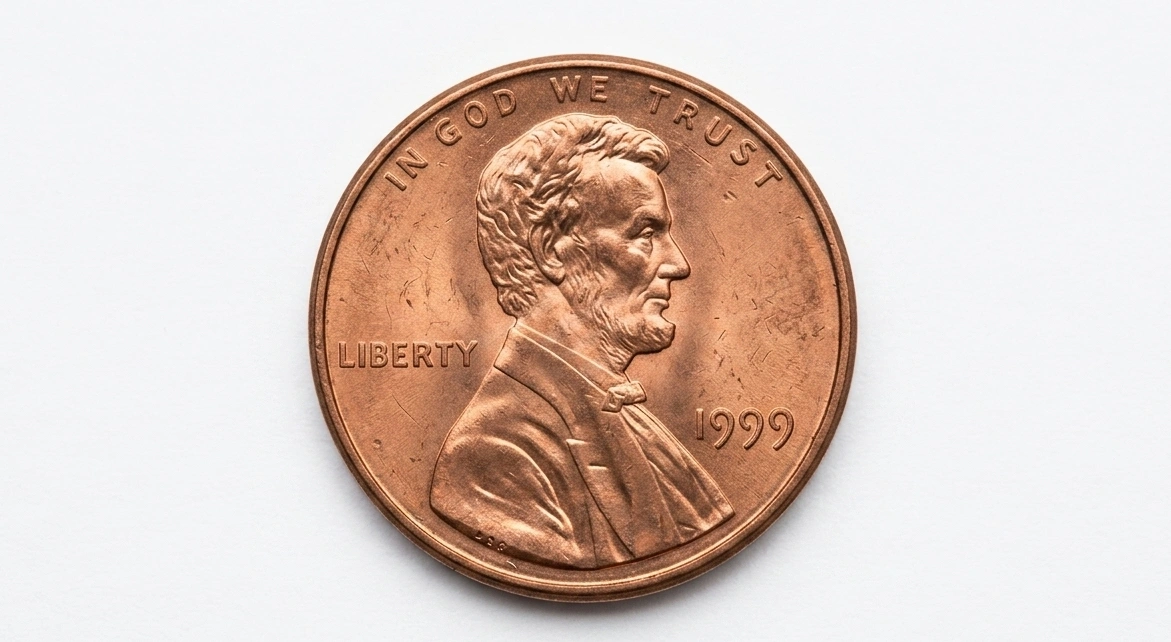
Check FG initials position relative to the Memorial.
Analyze the coin field for signs of chemical cleaning.
Audit Item №8: Rarity Comparison (1998-2000)
Cents with Wide AM were issued for three consecutive years in the late nineties.
1999 is recognized as the most valuable due to the minimum number of discovered specimens.
Year | Population | Status |
1998 | High | Common |
1999 | Low | Rare |
2000 | Medium | Scarce |
Average price for a 1999 MS-65 RD specimen exceeds the 1998 price by 20 times.
Audit Item №9: Plating Errors
Problems with Zinc core coating create visual anomalies.
Sometimes coins leave the press without any copper layer.
Such a specimen features a steel grey color and weighs less than the norm.
Full plating absence → $190.00 price.
Partial plating absence → $45.00 price.
Audit Item №10: Proof Minting Specifics
High-quality coins were issued for specialized sets.
Their relief possesses a frosted texture on a mirrored background.
Close AM is the standard for 1999 Proofs.
Wide AM appearing on ordinary coins represents using the "wrong" die.
Technical confusion created a numismatic rarity from a common coin.
Audit Item №11: Investment Forecast for 2026–2030
Market analysis confirms steady demand for modern US rarities.
Liquidity of certified Wide AM specimens is rated as high.
Asset Yield Forecast
Expected growth by 2030: +55% price.
Average annual increase: +11% value.
Investment horizon: 5 years.
Depreciation risk while maintaining grade: Minimal.
Audit Item №12: Long-term Preservation Conditions
Copper darkens quickly when contacting moisture.
Using high-quality accessories prevents grade drops.
Storage Protocol
Employing holders free of harmful plastics.
Placing silica gel in the container.
Avoiding direct sunlight.
Maintaining temperature within 18–22 degrees Celsius.
Stable environment → Preventing patina → Preserving worth.
Audit Item №13: Double Die Mechanical Classification
Numismatists divide doubling into classes based on the shift cause.
Class 1 (Rotated Hub): rotation during die manufacturing.
Class 5 (Pivoted Hub): tilting during design transfer.
Slight Class 1 manifestations are typical for 1999.
Any sharp date doubling increases worth tenfold.
Audit Item №14: Grease Strike Errors
Thick grease entering the die makes the strike blurry.
Digit 9 in the 1999 date often looks "faded".
Such a flaw is valuable only if major design elements disappear completely.
Single digit disappearance → $15.00 price.
LIBERTY inscription disappearance → $60.00 price.