
1918 Penny Value: A Coin Shaped by Wartime America
The production of copper cents in 1918 occurred during the closing stages of World War I, reflecting significantly on production volumes and raw material quality.
This coin, belonging to the Wheat Penny series, was struck at three US mints ensuring the increased demand for small fractional currency.
The market 1918 penny value of specimens today is determined exclusively by technical preservation parameters recorded by independent expert organizations.

The production of coins in 1918 followed the standards established by the Coinage Act of 1864, considering the production capacities of the wartime period.
Composition: 95% Copper, 5% Tin and Zinc mixture.
Weight: 3.11 grams.
Diameter: 19.05 millimeters.
Edge Type: Plain.
Designer: Victor David Brenner (VDB).
The use of old dies during the late production stages led to the appearance of coins with moderately blurred relief details, being accounted for during modern grading.
Mintage Statistics by Mint Location
The total output exceeded 450 million pieces, being distributed unevenly across production facilities.
Mint | Mark | Mintage (pcs) |
Philadelphia | None | 370,614,634 |
Denver | D | 47,830,000 |
San Francisco | S | 34,680,000 |
The mintage from the Philadelphia Mint remains a record for that period, comprising over 80% of the total 1918 output.
Impact of Preservation on Market Valuation
The value of the 1918 penny demonstrates non-linear growth depending on the coin's position on the 70-point Sheldon scale.
Circulated Condition
Specimens remaining in trade turnover possess significant wear, reducing their value to minimal levels.
Good-4 (G): The relief is heavily worn with inscriptions barely discernible, having a value of 0.15–0.30 USD.
Very Fine-20 (VF): Details of Lincoln’s hair and wheat lines remain partially visible, the price varying from 1.50 to 3.00 USD.
Extremely Fine-40 (XF): Wear affects only the highest points, the value reaching 5–10 USD.
Uncirculated Condition (Mint State)
Coins in Mint State (MS) grades represent the primary interest for investment attractiveness analysis.
MS-63: Moderate nicks are permitted, the price being 40–60 USD.
MS-65: An investment-grade level with bright luster, valued at 150–250 USD.
MS-67: An exceptional rarity with prices potentially exceeding 5,000 USD depending on color.
Copper Alloy Color Categories
The chemical properties of copper cause surface color changes upon contact with the environment, forming three price groups.
Brown (BN): Complete absence of mint luster, having a brown patina.
Red-Brown (RB): Presence of 5% to 95% original red color.
Red (RD): More than 95% original copper luster, ensuring the maximum price premium.
The absence of original red color reduces the value of a high-grade coin by 60–80% relative to bright red specimens.
Auction Records and Sales Statistics
Actual trading data confirms high price volatility in the upper preservation segment.
1918-D MS-66 RD (PCGS): Sold in 2007 for 14,950 USD.
1918-S MS-66 RD (PCGS): Realized for 21,850 USD in 2005.
1918 (P) MS-68 RD (PCGS): Reached a price of 31,200 USD at an auction in 2019.
Over the last 20 years, the price for specimens in MS-67 RD condition increased by 210%, demonstrating an average annual growth of 10.5%.
Annual Value Dynamics
Market cycle analysis reveals patterns in price changes for coins of varying quality.
Low Grades (up to XF): Stability with fluctuations of +/- 1% per year, corresponding to inflation expectations.
Mid-Grades (MS-60 — MS-64): Annual growth of 3.5–5% resulting from the gradual reduction of supply on the open market.
High Grades (MS-65+): Sharp value jumps up to 15% per year upon the appearance of new certified specimens or their transition into private funds.
Metal degradation due to improper storage leads to a 40% price drop during one oxidation cycle (transitioning from RD to RB).
Regional Features of the 1918 Issue
Each mint possessed technological process specifics influencing modern coin rarity.
Philadelphia (No Mark)
The massive mintage makes coins from this mint available in all grades up to MS-66.
Primary value is concentrated in specimens possessing a Full Strike of all wheat ear details.
Denver (D Mark)
1.918-D coins are often characterized by a weak strike in the central part of the reverse.
Specimens with sharp lines on the ears in RD condition are valued with a 30% premium over the base price.
San Francisco (S Mark)
This issue is recognized as the most difficult to find in Red condition.
High humidity in the region promoted rapid copper oxidation, making bright red 1918-S coins a scarce asset.
Defects and Minting Varieties
The existence of 1918 minting errors creates additional price markups.
Off-center strike: Image displacement by 10–25%, increasing the price by 50–150 USD.
Lamination error: Metal peeling due to impurities in the alloy, reducing the technical grade but creating interest for specialists.
Die Cracks: Raised lines on the field indicating equipment wear at the mint.
Unlike 1917, the 1918 issue lacks major Doubled Die varieties comparable in significance to the series' rarest samples.
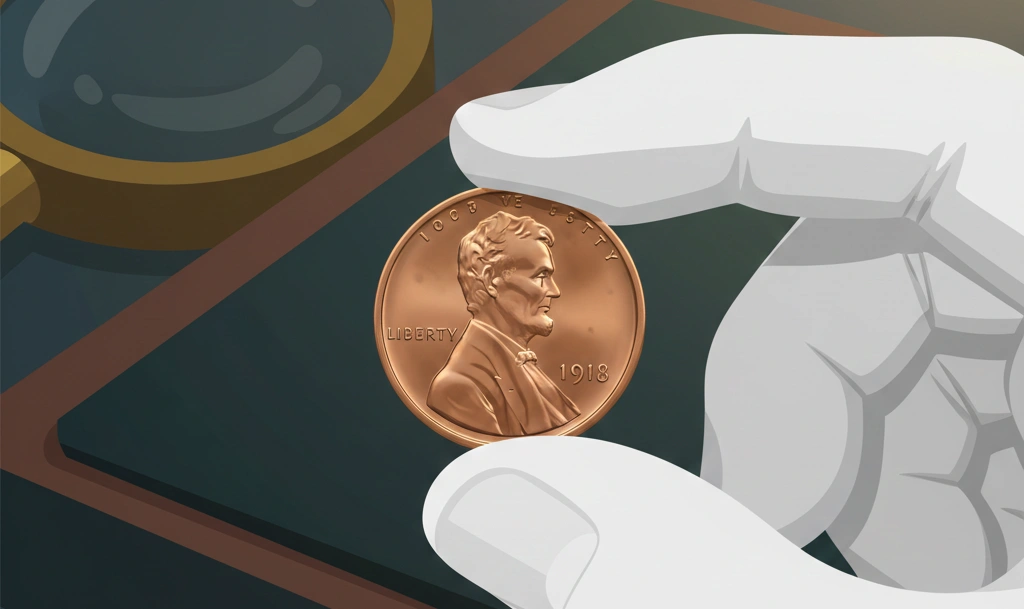
Methodology for Condition Assessment
Algorithmic approaches to surface analysis are applied to identify the exact grade with the free coin identifier app.
Determining the wear degree of wheat ear tips and Lincoln’s jawline.
Assessing the intensity and uniformity of mint luster.
Identifying microscopic bag marks obtained by the coin during transport.
Checking for traces of artificial cleaning, nullifying the numismatic markup.
Cleaning a coin with abrasives or chemicals reduces its liquidity by 70–90%, moving it into the "Details" category.
Price Forecast for a Ten-Year Period
Based on statistics from the last 30 years, a value forecast for 2035 can be compiled.
MS-63 RD: Predicted price of 85–100 USD (growth of ~60% from current levels).
MS-65 RD: Expected level of 450–550 USD (growth of ~100%).
MS-67 RD: Likely reaching the 12,000 USD mark due to supply shortages.
Demand stability is ensured by a fixed supply volume, as new finds of 1918 coins in ideal condition are practically excluded.
Role of Certification in Value Preservation
Possessing a slab from PCGS or a coin checker app is a mandatory condition for selling coins priced over 50 USD.
Certification ensures copper protection from further oxygen contact, preventing the transition from Red to Brown.
Coins in slabs possess liquidity exceeding that of "raw" coins by 4.5 times, according to data from major trading platforms.
Grade | Rarity (1-10) | Availability |
G - XF | 1 | Mass Market |
MS-60 - MS-64 | 3 | Moderate |
MS-65 RD | 6 | Limited |
MS-67 RD | 9 | Exceptional |
This distribution confirms that primary financial value is concentrated in the top percentage of preserved specimens.
Conclusion
The 1918 penny represents an asset whose value is strictly determined by the physical state of the metal.
The absence of subjective factors allows investors to operate with precise auction statistics data.
Adherence to technical storage conditions and focusing on the highest grading categories remain the only ways to ensure the profitability of this asset.
Market analysis confirms the 1918 issue's status as a reliable indicator of the US numismatic market's long-term health.